screws

Robotics in Python, built on screw theory: every rigid-body motion is a screw motion, the exponential of a twist, and an open chain is a product of such exponentials. Kinematics, Jacobians and dynamics all follow from that. The notation is that of Lynch and Park, Modern Robotics (MR).
- The mathematics. Rotations and rigid-body motions with their exponentials and logarithms; twists, wrenches and adjoints; forward and inverse kinematics; space and body Jacobians; manipulability and force ellipsoids; Newton-Euler dynamics; trajectories.
- Robots. A
Robotclass that carries M, the screw axes and the link inertias, a URDF loader, and three robots ready to use: a UR5, an RRP arm and a planar 2R arm. - Formulas.
screws.symbolicdoes the same computations in SymPy, so the product of exponentials, the Jacobians and the equations of motion come out in the joint variables. - Pictures.
screws.vizdraws a robot with its screw axes, animates screw motions, and shows Jacobians and manipulability ellipsoids, still or while the robot moves, with joint sliders in a notebook. - Simulation.
screws.coppeliadrives CoppeliaSim: read a robot off a scene, command it by position, velocity or torque, log and plot the run, and record a movie. - Checks.
screws.testingcompares your own implementation of a function with the library's.
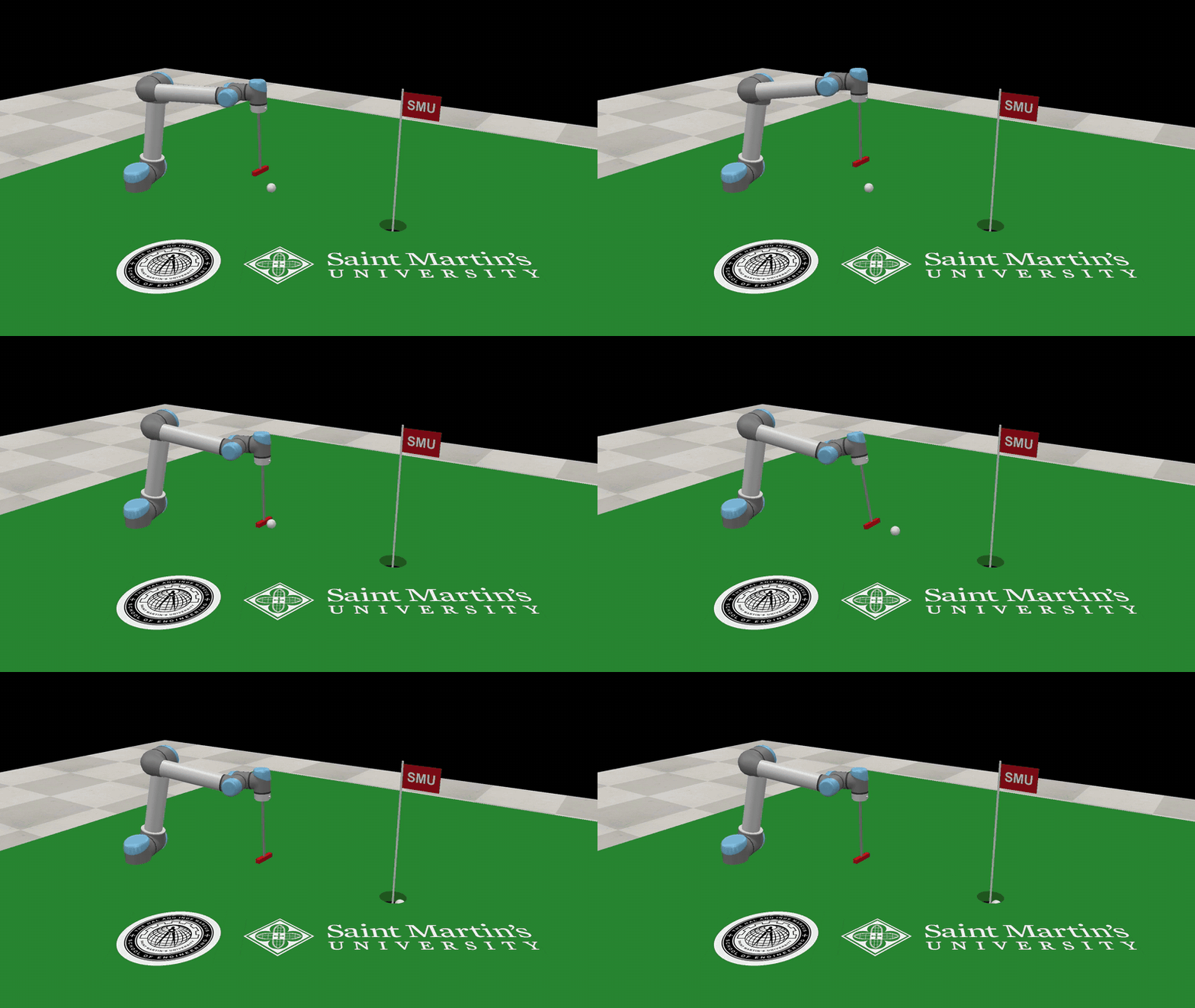
A UR5 sinks a putt in CoppeliaSim, driven through screws.coppelia. The package's own
pictures, of screw axes, screw motions, Jacobians and manipulability ellipsoids, are on the
Examples page, each with the lines that draw it.
screws started from the MR code library, and all of that library is still here: each
function under a snake_case name, with MR's name kept as an alias
(screws.FKinSpace is screws.fk_space). The tests run every example in MR's docstrings
through those aliases.
Four lines
import screws

ur5 = screws.robots.ur5()                          # M, screw axes, inertias from the textbook's URDF
T = ur5.fk([0.3, -1.2, 0.8, -0.4, 1.1, 0.2])         # a reachable, non-singular pose
result = ur5.ik(T, theta0=[0.1, -1.4, 0.1, 0.1, 1.4, 0.1])   # result.theta, result.converged, result.history
Where to go next
- Examples: what the package draws, with the code under each picture.
- Install the package, with the extras for pictures, the simulator and movies.
- Kinematics and the Robot class, dynamics and trajectories, and checking your own code against the library.
- Formulas: the same computations in SymPy.
- Pictures: the screw axes, screw motions, and Jacobians and manipulability ellipsoids.
- CoppeliaSim: driving the simulator, and a UR5 that putts.
- MR's names beside the
screwsnames, and the API reference.
Citing
Use CITATION.cff, or GitHub's
"Cite this repository" button, which reads it. Zenodo archives every release: the DOI
10.5281/zenodo.23873253 stands for screws as a whole and leads to the
latest version, and each version has a DOI of its own on that page.